
There was a brief period in photography that often gets overlooked. It sat somewhere between disposable film cameras and the smartphones we all carry today. It was the fun, early days of not really having the smartphone’s camera out all the time (even annoyingly at concerts and theme parks). The early 2000s were filled with tiny digital cameras that weren’t particularly sharp, fast, or technically impressive. Looking back, they weren’t remarkable because of their image quality. They were remarkable because they represented freedom. You snapped a shot and go back living in the moment.
You could finally take hundreds of photos without waiting for film to be developed. You could review them immediately on a tiny LCD screen, delete the blurry ones if you wanted, and start experimenting with photography in a way that film never quite allowed. Those first-generation digital cameras were full of limitations, but they also felt wonderfully optimistic. They represented a future that was just beginning.
That’s exactly what the new Kodak Charmera Millennium Edition reminds me of.
A Blind Box Worth Opening
Part of the fun begins before you even touch the camera.
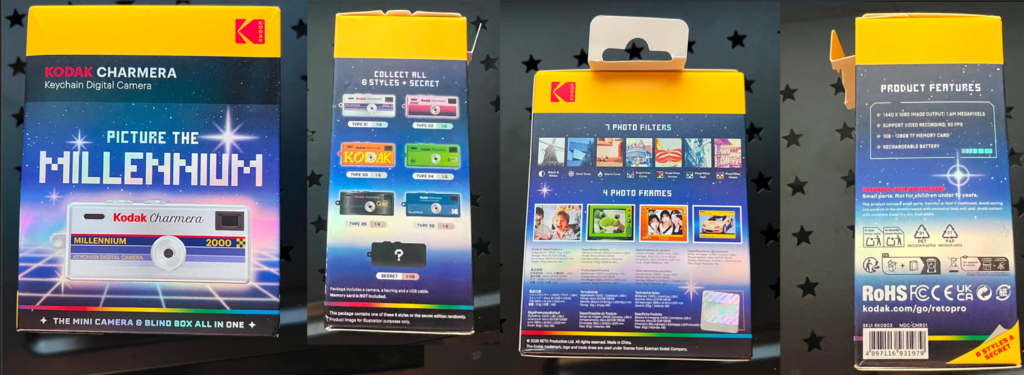
Like the original Charmera, the Millennium Edition comes packaged in a blind box. You don’t know which of the seven retro metallic finishes you’re getting until the box is opened. It reminds me a little of opening trading card packs as a kid. There is a tiny moment of anticipation where possibility is more exciting than certainty.
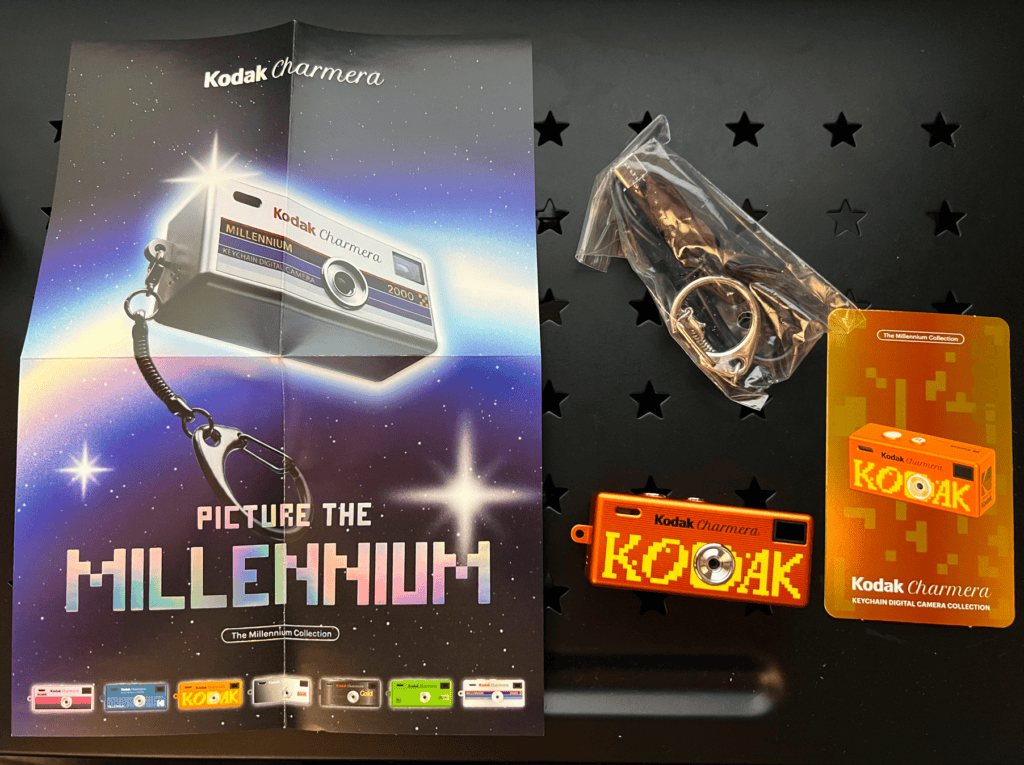
I ended up with the orange version, and I couldn’t be happier. It’s my 80’s inner child and 90’s teen that loved the orange colored things with glow-in-the-dark being even more beloved.
The metallic finish immediately stands out. Instead of feeling like a novelty toy, it has a bit more personality and polish. The orange finish reminds me of electronics from the turn of the millennium—bright enough to be playful without trying too hard to be modern. You got a poster and card with it as well.
Sometimes half the fun is simply not knowing which one you’ll receive.
Small Refinements That Matter
Functionally, the Millennium Edition remains very much the same camera. It still embraces low-resolution photography and intentionally imperfect images, which is exactly why I enjoy using it.
The improvements are mostly physical, but they’re meaningful.
The chrome buttons feel noticeably nicer under your fingers. They give the little camera a more premium appearance without changing its playful nature. The metal keychain also feels sturdier than before, making it seem like something that actually belongs attached to your everyday carry rather than being treated delicately.
Even the overall presentation feels more complete. It still has the same charm, but now it arrives with just a little more confidence.
It’s a reminder that refinement doesn’t always require reinvention.
Remembering Early Digital Photography
Underneath the updated exterior is still the same philosophy.
The Charmera uses a tiny 1.6-megapixel sensor paired with a fixed 35mm equivalent lens. Photos are intentionally low resolution. Contrast stays soft. Bright sunlight tends to bloom into highlights, while shadows gently lose detail. Videos are recorded in AVI format, just as many early digital cameras once did.
On paper, those specifications sound outdated.
In practice, they’re exactly the point.
The Millennium Edition doesn’t compete with modern smartphones because it was never designed to. Instead, it recreates the experience of photography at a time when simply owning a digital camera felt exciting.
Back then, we weren’t obsessed with pixel peeping. We weren’t zooming in to inspect sharpness or debating dynamic range. We were simply happy to have captured the moment.
That’s a refreshing feeling to revisit.
Imperfection as Character
One of my favorite things about the Charmera has always been how it handles light.
Bright California sunshine often overwhelms the tiny sensor. Highlights become soft, colors flatten slightly, and scenes take on that unmistakable early-2000s digital look. Modern cameras spend enormous amounts of processing power trying to eliminate those imperfections.
The Charmera embraces them.
Those washed highlights remind me of family vacations, birthday parties, and school field trips captured on inexpensive digital cameras twenty years ago. They don’t look technically perfect, but they feel emotionally familiar.
Memory isn’t perfectly exposed either.
When we think back to our childhood, we don’t remember every detail with crystal clarity. We remember fragments. We remember warmth. We remember movement. We remember how it felt.
The Charmera captures photographs in much the same way.
Photography Without Pressure
Using the Millennium Edition also changes how I photograph.
Because the camera is so simple, I stop worrying about settings. I stop checking every image immediately after taking it. Instead, I become more selective about when I press the shutter.
Ironically, carrying a camera with fewer capabilities often makes me more present.
I’m no longer trying to document every second of the day. I’m simply looking for moments that feel worth remembering.
A laugh between family members.
Morning light through a window.
A quiet street.
An unexpected reflection.
The camera quietly encourages intention.
Sometimes the Camera Stays in My Pocket
As much as I enjoy bringing the Charmera on family outings, I’ve also learned that the camera doesn’t need to come out for every moment.
There’s always a balance between preserving memories and fully living them.
It’s easy to spend an entire day chasing photographs, trying to capture every smile, every landmark, and every beautiful scene. But some of the richest memories happen when the camera stays in your pocket.
The conversations during a long drive.
Holding your child’s hand while walking somewhere new.
Standing quietly beside family as everyone takes in the same view.
Those experiences don’t need photographs to become unforgettable.
The Charmera works best when it complements the day instead of directing it.
More Than a New Edition
The Millennium Edition isn’t exciting because it has newer hardware.
It’s exciting because it celebrates an era of photography that many of us quietly miss.
An era when digital cameras were fun.
When limitations encouraged creativity.
When photographs weren’t immediately uploaded, edited, filtered, and forgotten.
The orange Charmera sitting on my keychain is a reminder that technology doesn’t always need to move forward to bring us joy. Sometimes it can simply remind us where we’ve been.
And perhaps that’s what the Charmera has always been about.
Not nostalgia for technology.
But nostalgia for how technology once made us feel.