
International travel always begins long before the airport. It begins in small, quiet moments — checking a passport drawer, pulling out an old suitcase that still smells faintly of the last trip, or standing in the kitchen wondering what it means to leave home for a while.
As I’ve gotten older, travel feels less like escape and more like transition. Crossing borders is exciting, but it also asks something of us: awareness, preparation, and responsibility — not just for ourselves, but for the people we travel with and the places we visit. Safety, in that sense, isn’t only about avoiding danger. It’s about creating enough stability that we can be present when we finally arrive.
Travel often begins with excitement — booking confirmations, packing lists, calendars slowly filling with plans. But over time, I’ve realized that the most meaningful part of travel happens quietly, long before the trip itself begins. It begins with intention. With slowing down enough to ask why we are going, and how we want to experience the time away. Mindfulness in travel isn’t about meditation or perfection. It’s about awareness — of what we carry with us, what we leave behind, and how we move through unfamiliar places once we arrive.
Preparation used to feel like a checklist. Pack clothes. Charge devices. Confirm reservations. Those steps still matter, but now I try to prepare something less visible: my attention. Before a trip, I make space to reflect on what this travel moment represents. Sometimes it’s a family vacation after a long stretch of routine. Sometimes it’s a visit to see relatives, where the destination matters less than the people waiting there. Framing the purpose of the trip changes how I pack and how I move through it. If the goal is connection, I pack lighter so I’m not burdened by things. If the goal is rest, I plan fewer activities and allow open space in the schedule. Mindfulness before travel is about aligning expectations with reality — accepting that we cannot do everything, and that meaningful experiences rarely come from rushing.
There is also mindfulness in how we leave home. Tidying up, watering plants, making sure everything is settled before departure creates a gentle transition rather than a chaotic exit. It allows the journey to begin calmly, instead of carrying lingering stress with us. Packing becomes a reflection of values. I no longer try to prepare for every possibility. Instead, I pack what supports presence: comfortable clothing, a few essentials, and items that help us settle quickly into a new place. When traveling with family, mindfulness shows up in the small things — snacks for the kids, familiar bedtime items, a lightweight blanket that feels like home. These objects don’t just serve practical purposes; they ease transitions and reduce friction, allowing everyone to be more present.
Travel doesn’t require excess. In fact, too much preparation can crowd out the very openness we’re hoping to experience.
Preparing the Mind Before the Bags
Before I pack anything physical, I try to prepare mentally. Traveling internationally means accepting that I will be a guest — in someone else’s culture, language, and rhythm. There’s humility in that. It reminds me that safety isn’t only about locking things down; it’s about moving through the world respectfully and attentively.
I remind myself that things will not go perfectly. Flights get delayed. Luggage takes longer than expected. Communication becomes slower when language barriers exist. Accepting these realities ahead of time softens the stress when they inevitably happen. Safety, I’ve learned, often comes from calmness — from the ability to pause, think clearly, and respond rather than react.
Documents: The Quiet Anchors of Movement
There is a certain weight to documents when traveling abroad. A passport isn’t just identification; it’s permission to move through the world. I make copies — physical and digital — not because I expect something to go wrong, but because preparation creates peace of mind.
Having a small folder with copies of passports, travel confirmations, and emergency contact information feels grounding. It’s not about fear; it’s about removing uncertainty. When everything is written down, I don’t have to hold it all in my head. That space can instead be filled with noticing new streets, new smells, and the subtle differences that make travel meaningful.
What I Bring, and Why It Matters
Packing used to feel like a logistical puzzle — how to fit everything into limited space. Now it feels more intentional. I don’t pack for every possible scenario; I pack for comfort, stability, and the ability to adapt.
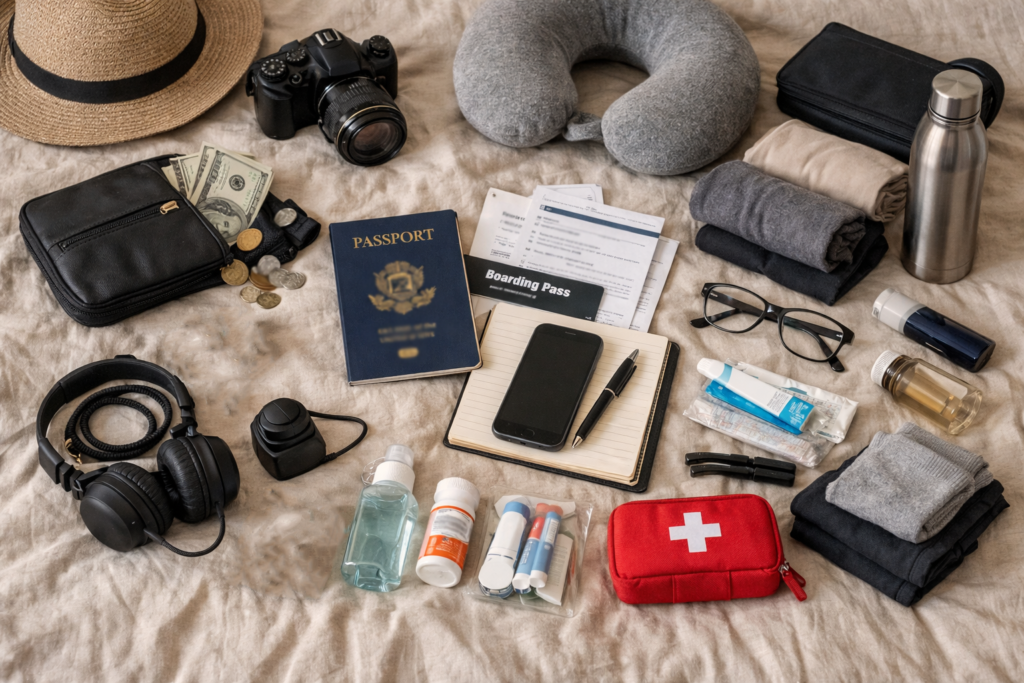
A small first-aid kit, basic medications, and familiar toiletries become small pieces of home. They reduce friction in unfamiliar environments. When traveling with family, especially, these small preparations matter. Children sense stability through routine — through the familiar objects that show up even in new places.
I also bring simple things that help us settle into a rhythm quickly: reusable water bottles, a light layer for changing climates, a notebook to jot down thoughts. None of these items are remarkable, but together they create continuity between home and wherever we land next.
Safety as Awareness, Not Fear
When I think about safety abroad, I don’t imagine worst-case scenarios. I think about awareness. Being attentive to surroundings, keeping belongings close, and understanding local norms are small acts that quietly shape the experience.
Learning a few basic phrases in the local language — hello, thank you, excuse me — does more than help communication. It signals respect. It opens doors to kindness that often becomes the most memorable part of a trip.
I also try to understand the rhythm of a place: when streets are busiest, when neighborhoods quiet down, how locals move through public spaces. Observing first, acting second — this approach has kept me grounded in unfamiliar environments. It turns travel into listening rather than imposing.
Remembering What Needs to Be Done Before Leaving
Preparation isn’t only about what we bring with us; it’s also about what we leave behind. Before an international trip, I slow down at home — checking small details that will matter once we’re gone. Holding mail, setting timers for lights, making sure important contacts know we’ll be away.
These tasks feel mundane, but they allow us to travel without lingering worry. When the home front feels stable, it’s easier to be fully present elsewhere. Travel becomes lighter, not because the journey is simple, but because the background noise of “what if” has been quieted.
Traveling With Family: Shared Responsibility
International travel with family carries a different kind of weight. It’s not just about personal preparation; it’s about collective care. Making sure everyone knows meeting points, keeping emergency contact information accessible, and talking through simple plans ahead of time creates a sense of shared responsibility.
There’s also something meaningful about these conversations. They remind us that safety is a collective act — that we look out for one another, especially in unfamiliar places. These small preparations often turn into moments of connection, quiet reminders that travel is something we experience together, not individually.
Letting Preparation Create Space for Presence
The goal of preparing for travel isn’t perfection. It’s freedom. When the essentials are taken care of, I can walk through a new city without constantly checking my bag or worrying about forgotten details. Preparation becomes invisible — a quiet foundation that allows the experience itself to take center stage.
Some of my favorite travel memories are small: sitting at a café watching people pass by, noticing how the light falls differently in another country, hearing my family laugh at something simple and universal despite language differences. None of these moments require perfect planning. They require space — mental and emotional — to notice them.
Arriving With Awareness
The moment we arrive somewhere new, it’s easy to switch into “tourist mode” — moving quickly from one destination to the next, trying to see everything before time runs out. But mindfulness invites a different pace.
I try to notice first, act second. The way the air feels different stepping out of the airport. The rhythm of traffic. The quiet cues of how locals move through public spaces. Observing before participating creates a sense of respect — a recognition that we are guests in someone else’s everyday life.
When we slow down, we begin to see things that aren’t on itineraries: the small neighborhood park, the smell of bread from a corner bakery, the way sunlight reflects off unfamiliar buildings. These details don’t demand attention, but they reward it.
Being Present During the Trip
Mindfulness during travel is less about doing more and more about noticing more. It’s choosing to sit for a moment rather than constantly moving. It’s allowing conversations with family to unfold naturally, without feeling pressured to reach the next attraction.
There are moments on every trip when things don’t go according to plan — delays, wrong turns, unexpected closures. Mindfulness doesn’t prevent these moments, but it changes how we respond to them. Instead of frustration, we pause. Instead of rushing, we adjust. Often, those detours become the stories we remember most clearly.
I’ve learned that presence during travel often comes from putting devices away for stretches of time. Taking photos is important to me, but I try to photograph lightly — capturing enough to remember, but not so much that documentation replaces experience. When I look back later, the imperfect images often carry more emotional weight because I remember how the moment felt, not just how it looked.
Traveling Together, Paying Attention Together
Traveling with family deepens this practice of mindfulness. Children naturally notice details adults overlook — a street musician, an interesting door, a stray cat weaving through a crowd. When I slow down enough to follow their attention, the trip becomes richer.
Mindfulness in family travel is also about patience. Recognizing when someone needs rest, when plans need to shift, when the day is better spent wandering than checking off a list. These adjustments aren’t failures of planning; they’re signs that we’re listening to one another.
Travel becomes less about destinations and more about shared presence — about being fully there, together.
Bringing Safety Home Again
Returning from international travel carries its own kind of reflection. I unpack not just clothes, but impressions — small lessons about how other places move through the world. Preparation and safety fade into the background, replaced by gratitude that the journey allowed us to grow, even in subtle ways.
Mindfulness doesn’t end when the trip does. Returning home is another transition that deserves attention. Unpacking slowly, reflecting on moments that stood out, and sharing stories over dinner helps the experience settle into memory.
I’ve found that when travel is approached mindfully, the effects last longer. We carry back small shifts in perspective — appreciation for different ways of living, gratitude for what we have, and a renewed sense of connection with the people we traveled with.
Travel, in this way, becomes less about escape and more about awareness. It reminds us that the world is wide, but also that presence can be practiced anywhere — at home, on the road, and in the quiet spaces in between.
Each trip teaches me that safety isn’t about control. It’s about readiness, awareness, and respect — for ourselves, for our families, and for the places that welcome us, even briefly. Travel will always carry uncertainty. But with thoughtful preparation, that uncertainty becomes something else: openness. And in that openness, the world feels both larger and more connected — a place where home can be carried quietly within us, no matter how far we go.
Suggested Travel Essentials and Bits and Bobs
Yes, I am listing electronics first but that’s just how I am, so skip those if you’re not as tech-oriented.
- Anker Nano Travel Adapter, 5-Port Power Adapter with 1× 2-Pin AC, 2 USB A, 2 USB C for 20W, Smart Temperature Control
- Anker Travel Power Strip – don’t want to get your phone, camera, and other electronics fried during the travel
- FYY Travel Cable Organizer Pouch Electronic Accessories Carry Case Portable Waterproof Double Layers All-in-One Storage Bag – Just keep in mind that you may need one for each person you are traveling with. It’s like a personal organizer for wire, headphones, and charger.
- INIU Portable Charger, Ultra Slim 45W Fast Charging with Attached USB C Cable, Flight-Safe 10000mAh – Here’s the problem with portable charger batteries: you can’t have it to be too large but if it’s too small the it’s not useable. This one is a balance of size and portability.
- napfun Neck Pillow for Traveling, Upgraded Travel Neck Pillow for Airplane 100% Pure Memory Foam Travel Pillow for Flight Headrest Sleep – I had to upgrade my neck pillow to memory foam since the pillow at home I use is the same material. Great for nodding off during flights.
- Airtag Passport Holder Cover Wallet Travel Essentials RFID Blocking Leather Card Case – RFID protection and AirTag pocket for safety.
- travel inspira Luggage Scale, Portable Digital Hanging Baggage Scale for Travel, Suitcase Weight Scale with Rubber Paint, 110 Pounds – I may get a talk-to about this but if you’re traveling with older in-laws, you may need this thing. I had to tell my father-in-law once that we couldn’t take all the local dry herbs home on our carry-on because of the weight limit. This showed him the actual weight and allowed him to try to hit a weight goal.
- MATEIN Carry on Backpack, Extra Large Travel Backpack Expandable Airplane Approved Weekender Bag for Men and Women, Water Resistant Lightweight Daypack for Flight 40L – I thought my floppy duffle bag from college was enough for a carry-on but as I grow older, I wanted something stiffer and easier to stow. I’ve regulated that floppy duffle bag to the back trunk as a roadtrip carry now.
- Amazon Essentials 4-Piece Packing Cubes Travel Accessories Set, Luggage Organizer, Suitcase Organizer with Double Zipper – I didn’t like travel cubes until I did. I was the type that just crammed everything into the bag and left the house, but I realized how easy (and less wrinkled) it is to grab “just” the bag you needed without riffling through the whole bag. Now I can just pull out the “socks” cube and not have to deal with my He-man boxers falling out during flights.
- MiiKARE Travel Essentials Airplane Phone Holder, Universal Handsfree Phone Mount for Flying with 360 Degree Rotation – In-flight entertainment is OK, but sometimes I’d rather watch my own thing or play games. This headrest attachment allows you to have your phone at eye-level and secured. I would also suggest an 8BIT-DO bluetooth controller if you’re going to game. See next item on list!
- 8BitDo SN30 Pro Bluetooth Controller, Hall Effect Joystick Update, Compatible with Switch, PC, macOS, Android, Steam Deck & Raspberry Pi (Gray) – I have an iPhone (don’t hate) and this is the bluetooth travel controller you’ll want when you’re on the go. It’s like an updated SNES controller with analog sticks to play fighting and driving games.