
There’s something about standing in front of vast landscapes that rearranges you internally. You just can’t believe your eyes and you keep staring as if you’d wake up from a dream. You start to think about life and the grand scheme of things. Photos never quite prepare you. You think you understand scale. You think you know what to expect. And then you arrive, step out into the dry desert air, and realize how small you are in the best possible way.
Horseshoe Bend, Antelope Canyon, and Monument Valley aren’t just destinations on a map. They are reminders. Reminders that time is patient, that land moves slowly, and that human urgency means very little in the presence of stone shaped over millions of years.
The Bend in the River
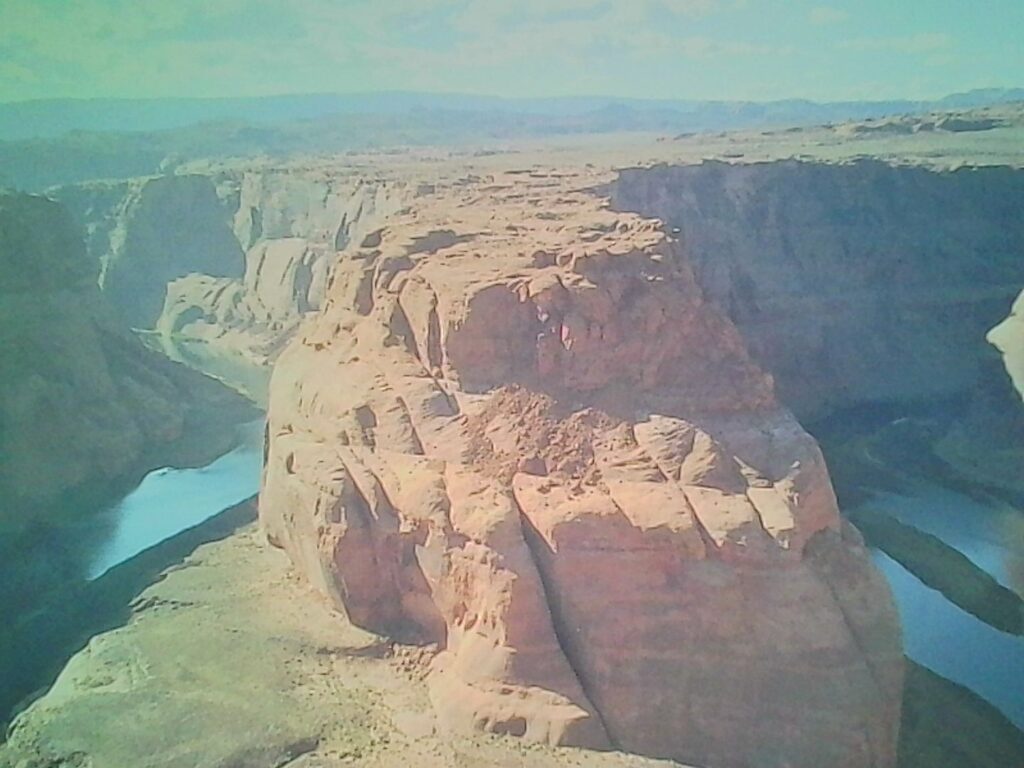
At Horseshoe Bend, the Colorado River curves in a perfect arc, as if guided by a hand that never rushes. Standing at the edge, you feel the wind first. Then the height. Then the silence. The river below doesn’t look hurried. It doesn’t care that you drove hours to see it. It continues its slow carving, just as it has for ages.
From above, the water appears calm, almost gentle. But you know that it is forceful enough to shape rock, to bend earth, to create something so symmetrical it feels designed. That realization humbles you. It reminds you that persistence, not speed, changes landscapes.
Looking down, I felt both small and steady. Small because of the scale. Steady because the earth itself seemed to whisper that everything takes time.
Looking Up in Antelope Canyon
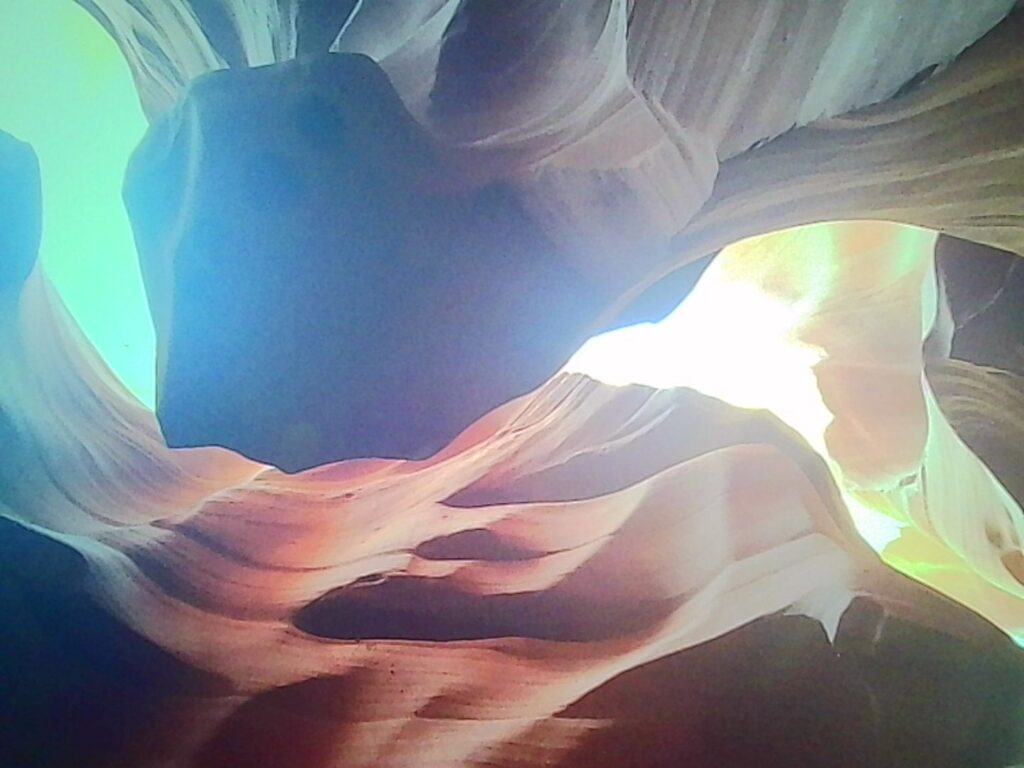
If Horseshoe Bend makes you look down and outward, Antelope Canyon makes you look up.
Inside the narrow passageways, light pours in from above in thin, sacred beams. The walls curve and ripple like frozen waves. You run your hand across the sandstone and feel softness where you expected hardness. The canyon was shaped not by one dramatic event, but by flash floods over countless seasons — water moving quickly through tight space, carving and smoothing with quiet persistence.
Standing there, craning your neck to follow the lines of the rock upward, you realize how little control we have over time — and how beautiful that can be. The desert sky above is bright and dry, almost severe in its clarity. Yet inside the canyon, the light becomes gentle, filtered, warm.
It felt like stepping inside time itself.
The walls are not symmetrical. They are not engineered. They are patient. Each curve is the result of thousands of small moments — storms, floods, winds, heat — repeating themselves long before anyone thought to visit.
Monument Valley’s Pillars
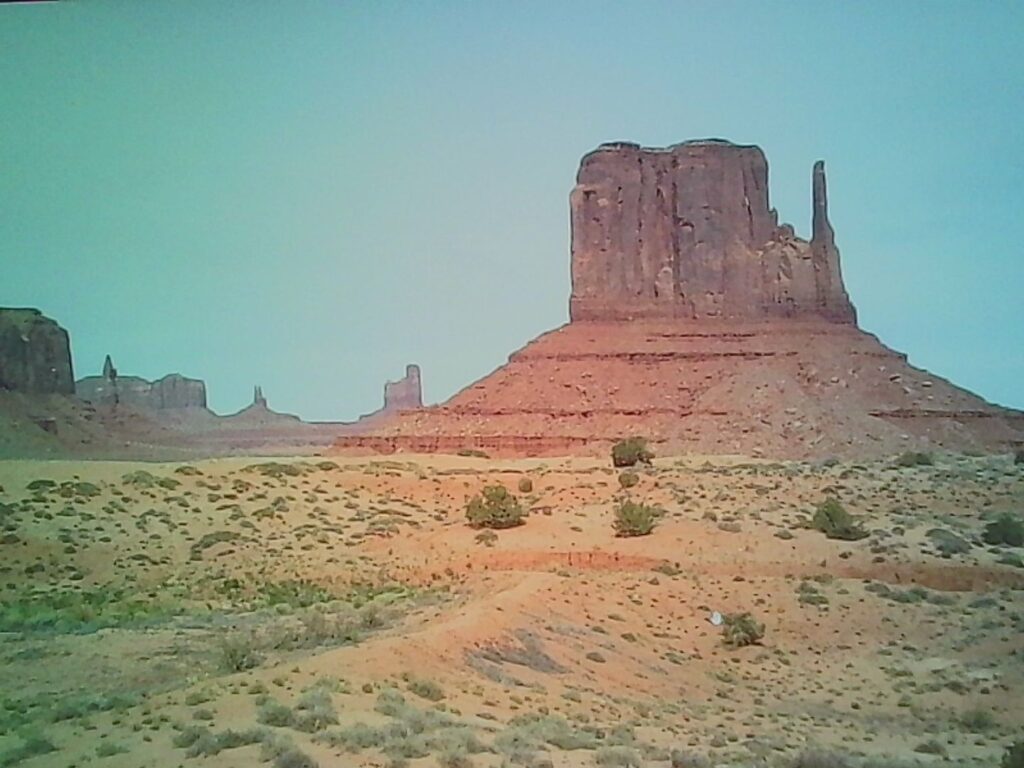
Monument Valley shifts the perspective again. Instead of looking down or up, you look outward — across open space punctuated by towering red rock pillars rising from the earth like ancient guardians.
Driving into the valley feels cinematic, but being there strips away that drama. The formations stand without performance. They don’t need to impress. They simply exist.
The sky feels wider there. The desert stretches without apology. The dry air carries a stillness that quiets conversation. You don’t speak loudly in places like that. You don’t need to.
The pillars have stood through centuries of change — weather patterns, cultural shifts, generations passing. And there you are, a visitor for an afternoon, trying to absorb something that has taken millions of years to form.
Humility settles in gently.
The Desert and Time
The desert is often misunderstood. People describe it as empty. But standing there, it feels full — full of time, of memory, of quiet endurance.
The dryness of the air sharpens your senses. The light feels different. There’s less distraction, fewer layers of sound. The land reveals itself slowly. And when you allow yourself to move at that pace, something inside you adjusts.
These places were not shaped overnight. They were carved by wind and water, by heat and patience. They remind you that not everything needs acceleration. That growth, erosion, and transformation can happen without spectacle.
In the desert, you can feel the passage of time.
The Open Road
Part of the experience isn’t just the destinations, but the drive between them.
The open road across the Southwest feels endless in a way that’s comforting. Miles of highway stretching forward, horizons that don’t rush toward you, and sky that refuses to feel confined. There’s something freeing about driving through such openness with family beside you.
Conversations drift in and out. Silence becomes comfortable. Music plays softly. You pass small towns, stretches of nothingness, and landscapes that change subtly over hours.
The road becomes its own kind of meditation.
Traveling this way slows you down. You’re not hopping from flight to flight. You’re watching the land unfold gradually. The journey itself becomes as meaningful as the sites you’re heading toward.
Family in Big Places and Photo Opportunities
Experiencing these places with family adds another layer.
When you stand together at the edge of Horseshoe Bend, when you tilt your heads back inside Antelope Canyon, when you gaze out at Monument Valley’s pillars — you’re not just seeing landscapes. You’re sharing perspective.
There’s something powerful about witnessing humility together.
In everyday life, it’s easy to feel large — large responsibilities, large worries, large plans. But in front of landscapes shaped by millions of years, those concerns shrink into proper proportion.
And that’s a gift.
Traveling as a family through places like this isn’t about checking boxes. It’s about expanding inwardly. It’s about recognizing how small we are and how connected we are at the same time.
I brought the Charmera along for this trip, knowing it wouldn’t capture the grandeur in the way modern cameras try to. It renders scenes the way old disposable cameras did — bright sun blooming into the frame, colors softening at the edges, highlights sometimes washing over detail. In a place like this, the desert light is relentless. It flattens shadows, bleaches stone, and turns the sky into a sheet of white heat. And somehow, that imperfection feels right. The photos don’t attempt to contain the immensity of Horseshoe Bend or Monument Valley. They offer only a touch of it — a suggestion rather than a statement. The washed light becomes part of the memory, just as the dry air and glare were part of standing there. Instead of overpowering the scene, the Charmera humbly acknowledges that some landscapes are too vast to be fully held. It captures not the scale, but the feeling of being small beneath it.
Carved by Time
The phrase keeps returning: carved by time.
Not rushed. Not forced. Not manufactured.
Carved slowly, consistently, patiently.
Horseshoe Bend curves because water persisted.
Antelope Canyon ripples because floods repeated.
Monument Valley stands because erosion revealed what endured.
There’s something reassuring about that.
It suggests that the most meaningful things in life — character, relationships, understanding — are also carved slowly. They don’t appear overnight. They take time, weather, pressure, and patience.
Standing in those landscapes, I didn’t feel insignificant. I felt aligned. As if the land itself was reminding me to trust the long process.
Carrying It Home
When we drove away from Monument Valley, the pillars slowly shrinking in the rearview mirror, I thought about how different the world feels when you’ve stood inside something that old. All that left was dust on our shoes, but it was the memory that mattered.
The desert doesn’t follow you home, but the perspective does.
You remember how small you felt — and how steady that smallness was. You remember the open sky, the dry air, the stillness. You remember the road and the shared silence.
And you begin to see daily life a little differently.
Maybe that’s what travel like this is really for. Not to collect photos, not to gather proof that you were there, but to recalibrate. To be reminded that time is vast, that patience shapes everything, and that the best way to move through the world is together — along open roads, under wide skies, humbled and grateful.
Carved by time.
And still shaping us.